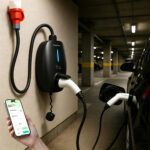
You already know that electric vehicles save money on fuel. They also reduce maintenance costs. But did you know your EV can do much more than just drive? With smart charging and vehicle-to-grid (V2G) technology, your car becomes an active part of your home’s energy system. It can even earn you money. These technologies are rapidly maturing in 2026. Yet many EV owners have never heard of them. At Changzhou Fisher Electronic Technology Co., Ltd., we believe that smart charging is the future. This post explains what smart charging and V2G actually do. You will learn how they work, why they matter, and how to get started.
What Is Smart Charging? A Simple Explanation
Smart charging sounds technical. But the concept is straightforward. A traditional charger simply delivers power when plugged in. A smart charger decides when and how fast to deliver that power. It makes these decisions based on real-time information.
What kind of information? Electricity prices. Grid demand. Your solar panel output. Your planned departure time. The smart charger uses this data to optimize charging. The result? Lower electricity bills. Less strain on the grid. And more renewable energy used automatically.
For example, imagine you plug in at 6 PM. Electricity prices are high because everyone is cooking dinner. A smart charger waits until midnight when prices drop. Your car still finishes charging by 7 AM. You saved money without lifting a finger.
Smart charging also supports load balancing. If your home runs the oven, dryer, and air conditioner simultaneously, the charger reduces its current temporarily. After other appliances finish, the charger ramps back up. Your main breaker never trips.
Many smart chargers include mobile apps. You can schedule charging, monitor energy use, and adjust amperage from anywhere. Some integrate with home energy management systems. Others work with utility demand response programs. In exchange for allowing the utility to briefly pause your charging during peak events, you receive bill credits.
The key enabler of smart charging is OCPP. The Open Charge Point Protocol allows chargers and software to talk to each other. With OCPP, you are never locked into one app or network. You can switch providers freely. That is real freedom.
Why Smart Charging Matters for Your Wallet
Let us talk about money. Electricity rates are not flat. Most utilities charge more during peak hours (4 PM to 9 PM) and less overnight. A dumb charger plugged in at 6 PM pays the peak rate. A smart charger waits for off-peak rates.
The savings add up quickly. Suppose your off-peak rate is 0.08perkWhandyourpeakrateis0.08perkWhandyourpeakrateis0.22 per kWh. Over a year of 4,000 kWh for driving, the dumb charger costs 880.Thesmartchargercosts880.Thesmartchargercosts320. That is a 560annualdifference.A560annualdifference.A600 smart charger pays for itself in just over a year.
Many utilities also offer incentives for smart charging. They may give you a rebate for buying an eligible charger. Some provide a monthly credit just for enrolling in their demand response program. During extreme grid events, they may ask you to pause charging for an hour. You barely notice. Your wallet does notice the credit.
Solar owners benefit even more. Without smart charging, your solar panels send excess energy to the grid for low feed-in tariffs. A smart charger can divert that excess solar power directly into your EV battery. You use your own clean energy instead of buying from the grid. This maximizes your solar investment.
Finally, consider time-of-use billing for commercial fleets. A fleet of 10 delivery vans charging intelligently can save thousands of dollars per year. The software is the same. Only the scale changes.
Smart charging is not a luxury. For anyone who pays an electricity bill, it is a financial no-brainer.
Understanding Vehicle-to-Grid (V2G) Technology
Smart charging only controls when power flows into your EV. V2G goes further. It allows power to flow out of your EV and back to the grid. Your car becomes a battery on wheels.
How does that work? V2G chargers use a bidirectional inverter. Standard AC chargers convert grid AC to DC for your battery. Bidirectional chargers can also convert battery DC back to AC and send it to your home or the grid. Your EV’s battery management system coordinates this safely.
When would you use V2G? Imagine a hot summer evening. Air conditioners are running hard. The grid is stressed. Your EV is parked at home with 70% charge. The utility sends a price signal. It offers $0.50 per kWh for any energy you send back. Your V2G charger automatically sells back 30% of your battery, leaving you 40% for driving tomorrow. You earn money while your car sits idle.
V2G also enables vehicle-to-home (V2H) for backup power. When a storm knocks out your grid connection, your EV powers your refrigerator, lights, and internet. No generator needed. No extension cords. Just plug your car into your V2G charger and flip a switch.
The technology is already real. In 2026, several automakers offer V2G-capable EVs. Examples include the Nissan Leaf, Mitsubishi Outlander PHEV, Hyundai Ioniq 5, and Ford F-150 Lightning. Many more models are coming. Charger manufacturers like Fisher are launching bidirectional models certified for V2G.
Regulatory approval is expanding too. Eight US states now have V2G pilot programs. Europe’s V2G market is even more advanced, with commercial projects in the UK, Netherlands, and Germany. The pieces are falling into place.
Common Concerns About V2G (And Why They Are Overblown)
Many drivers worry about V2G. Will it wear out my battery faster? Will I be stranded with a dead car? These concerns are understandable but largely outdated.
First, battery degradation. Early lithium-ion batteries had limited cycle life. Modern EV batteries are far more durable. They routinely last 500,000 kilometers or more. V2G adds extra cycles, but these are shallow cycles. Discharging 10% or 20% of capacity is much gentler than a full deep discharge. Studies from the University of Warwick and others show that V2G has minimal impact on battery lifespan when managed properly. Thermal management and charge limits protect the battery.
Second, range anxiety. You control how much energy your car can sell. Set a minimum state of charge, say 40%. The V2G system will never go below that. You always have enough range for unexpected trips. Most drivers can easily spare 30% of their battery most days.
Third, warranty concerns. Some early EV warranties excluded V2G use. That has changed. Major automakers now explicitly support V2G in their warranty terms. Always check your specific model. But the trend is clear: V2G is becoming an expected feature, not a voided warranty risk.
Finally, equipment cost. Yes, bidirectional chargers cost more than one-way chargers. Expect to pay 800to800to1,500 more. However, incentives often cover part of that cost. And the revenue from selling grid services can recoup the difference in two to three years. After that, the V2G charger earns money for you.
V2G is not for everyone today. If you have an older EV or very low electricity rates, the math may not work yet. But for many drivers, especially with solar panels or time-of-use rates, V2G is already a smart investment.
How to Get Started with Smart Charging Today
You do not need to wait for V2G. Smart charging is available right now. Here is how to set it up.
Step 1: Buy an OCPP-compliant smart charger. Look for OCPP 1.6 or 2.0.1 support. This ensures compatibility with multiple apps and utilities. Fisher chargers include OCPP out of the box.
Step 2: Install the charger. Follow the same installation process as any Level 2 charger. Use a licensed electrician. Ensure your Wi-Fi or Ethernet reaches the charger location.
Step 3: Connect to a smart charging platform. Many platforms exist. Examples include Monta, ev.energy, and ChargeLab. Some are free. Others charge a small monthly fee. The platform connects to your utility’s pricing data and your charger.
Step 4: Set your preferences. Tell the platform your desired departure time. Set a minimum charge level. Choose whether to participate in demand response. The platform then optimizes automatically.
Step 5: Monitor and adjust. Most platforms provide an app. You can see how much money you saved. You can also override the schedule manually if you need a faster charge today.
That is it. You are now smart charging. No complex programming. No daily decisions. The software handles everything.
For V2G, the process is similar but requires a bidirectional charger and utility approval. Start with smart charging first. Once comfortable, upgrade to V2G when your utility offers a program.
Real-World Savings from Smart Charging and V2G
Let us look at actual numbers. Consider a homeowner in California with time-of-use rates. Peak rates are 0.30perkWh.Off−peak(midnightto6AM)is0.30perkWh.Off−peak(midnightto6AM)is0.10 per kWh. Without smart charging, they pay 0.30formostoftheirEVenergy.Withsmartcharging,theyshift900.30formostoftheirEVenergy.Withsmartcharging,theyshift90800.
Now add solar. Their solar panels produce excess energy from 10 AM to 3 PM. The smart charger captures that excess, avoiding the low feed-in tariff of 0.05perkWh.Insteadofsellingat0.05perkWh.Insteadofsellingat0.05, they use it to charge at 0.00.Another0.00.Another200 saved.
Finally, add V2G. On five summer days, the utility pays 1.00perkWhforexportedenergy.Theyexport10kWheachtime.Thatis1.00perkWhforexportedenergy.Theyexport10kWheachtime.Thatis50 per year. Small, but growing as programs expand. In the UK, some V2G participants earn £300-500 annually.
Total annual benefit: over 1,000.Overfiveyears,thatis1,000.Overfiveyears,thatis5,000 back in your pocket. The charger pays for itself many times over.
Commercial fleets see even larger returns. A 20-van fleet shifting charging to off-peak saves 15,000to15,000to25,000 per year. V2G exports during peak demand add another 5,000to5,000to10,000. Smart charging is not just an environmental choice. It is a competitive business advantage.
Future Trends: Where Smart Charging and V2G Are Headed
The year 2026 is an inflection point. Several trends are accelerating.
Automaker integration. Tesla, Ford, GM, and Hyundai now include smart charging profiles in their vehicle software. Your car can tell the charger your desired departure time and battery limit. No separate app needed.
Utility programs going mainstream. Five years ago, only a few utilities offered smart charging tariffs. Today, over 50 US utilities have programs. Europe and Australia are even further ahead. Expect near-universal availability by 2028.
Second-life batteries. Retired EV batteries still have 70-80% capacity. These are perfect for stationary storage paired with V2G chargers. Homes and businesses can stack multiple batteries for grid services.
Blockchain and peer-to-peer energy trading. Some pilot projects allow neighbors to trade EV energy directly. Your charger sells to the house next door without going through the utility. This is experimental but promising.
Virtual power plants (VPPs). Aggregators combine thousands of V2G-enabled EVs into a single virtual power plant. They bid into wholesale electricity markets. Participants earn much higher rates than retail export tariffs. VPPs are already operating in Australia and Texas.
These trends mean that waiting has a cost. The sooner you adopt smart charging, the sooner you start saving. And as V2G rolls out, you will already have the right hardware.
Why Fisher Smart Chargers Are the Right Choice
At Changzhou Fisher Electronic Technology Co., Ltd., we built smart charging into our DNA. Every Level 2 charger we sell comes with OCPP compliance. No extra fees. No proprietary lock-in.
Our chargers feature:
- Built-in Wi-Fi, Ethernet, and optional 4G
- Load balancing for multiple units
- Solar surplus capture ready
- Over-the-air firmware updates
- IP65 weatherproof rating for outdoor use
- UL and CE certification
We also offer bidirectional models for V2G. These units include automatic islanding for backup power. When the grid fails, they disconnect and power your home safely. No backfeed risk to utility workers.
Our technical support team helps you configure smart charging platforms. We provide documentation for utility interconnection. And our pricing remains competitive because we believe in making smart charging accessible to everyone.
Visit our website to see the full range. Whether you need a single home charger or a fleet of V2G stations, Fisher has a solution.
Take Control of Your Energy Future
Smart charging and V2G are not science fiction. They are available today. They save you money. They reduce grid stress. They let you use more solar energy. And they turn your parked car into an earning asset.
Do not wait until the technology is perfect. It is already good enough. Start with a smart charger. Configure it with your utility’s rates. Watch your electricity bill drop. Then, when your utility launches a V2G program, upgrade your charger or enable the bidirectional feature you already purchased.
The future of EV charging is intelligent, interactive, and profitable. At Changzhou Fisher Electronic Technology Co., Ltd., we are proud to lead the way. Join us. Plug in smarter. Drive cleaner. And let your EV work for you, even when you are not driving.
Contact our team today. We will help you choose the right smart charger for your home or business. Your wallet will thank you. We will help you choose the right smart charger for your home or business. Your wallet will thank you.