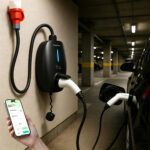
Introduction: Rising Demand for Compact EV Charging Solutions
Global electric vehicle adoption keeps rising steadily in 2026. More families and businesses switch to eco-friendly EV travel modes. This shift creates huge demand for reliable charging infrastructure. Traditional floor-mounted chargers occupy extra ground space. They also require complex installation procedures in tight areas. For this reason, wall-mounted charger stations gain rapid market popularity this year.
A 2026 global industry report confirms clear market growth trends. The wall-mounted charger market reached USD 1.42 billion in 2026. It will hit USD 5.22 billion by 2032 with stable annual growth. Meanwhile, new global safety standards take full effect in 2026. These standards force all charging devices to pass unified certification checks. Wall-mounted chargers fully meet these updated compliance requirements. Thus, they become the mainstream choice for residential and commercial scenarios.
Furthermore, user charging habits have changed greatly. Nearly 77 percent of EV owners prefer home wall-mounted charging in 2026. They choose home charging for lower costs and higher convenience. Public charging piles often face queuing and compatibility issues. In contrast, wall-mounted chargers deliver stable, private charging services. This article analyzes their core strengths, 2026 industry highlights, application values and future potentials.
Core Advantages of Wall-mounted Charger Stations
Space-saving and Flexible Installation
Space utilization stands out as the biggest advantage of wall-mounted chargers. These devices fix directly on building walls or parking partition boards. They take up zero floor space in parking areas. This feature suits urban residential parking lots perfectly. Modern urban parking spaces usually have limited reserved areas. Floor-mounted chargers often block pedestrian and vehicle passages. Wall-mounted models avoid this problem completely.
In addition, their installation flexibility supports diverse scenarios. Users can adjust installation heights according to actual needs. Property managers can arrange charger layouts in a neat and unified way. The whole installation process consumes less time and labor. It also causes minimal damage to building decoration structures. Therefore, both residential communities and office buildings favor this design.
Stable Performance and Standardized Safety
2026 new national and international safety regulations upgrade charging safety thresholds. All qualified wall-mounted chargers adopt unified CCC certification standards. These standards eliminate most compatibility failures between vehicles and chargers. They reduce common problems like charging pause and signal disconnection.
Moreover, mainstream 2026 wall-mounted models integrate multiple safety protections. They support over-current protection and over-voltage protection. They also add leakage protection and over-temperature automatic power-off functions. These mechanisms prevent daily charging risks effectively. They create a safe charging environment for private and commercial use. Compared with ordinary household sockets, wall-mounted chargers offer far more stable power output. They avoid unstable current that harms EV batteries.
Cost-effective Operation and Maintenance
Wall-mounted charger stations bring obvious cost benefits for long-term use. First, their one-time installation cost stays at a moderate level. They do not need expensive ground foundation construction. Second, their structural design is simple and compact. This design lowers daily maintenance difficulty greatly.
Meanwhile, most 2026 updated models support intelligent power adjustment. They match power output with different EV battery parameters accurately. This matching improves overall charging efficiency. It also cuts unnecessary power waste. For enterprise fleet charging and community shared charging, these cost-saving features bring stable economic benefits.
2026 Hot Industry Trends of Wall-mounted Charger Stations
Widespread Popularization of Smart Connection Functions
Intelligent upgrading becomes the core development trend in 2026. Nearly 60 percent of new wall-mounted chargers support smart network connectivity. Users can bind devices with mobile phone apps easily. They can remotely start, pause and monitor charging processes in real time.
Besides basic remote control, smart functions expand continuously. More models support automatic charging schedule setting. Users can set charging tasks during off-peak electricity periods. This function helps users save household and corporate electricity expenses. In addition, real-time data statistics become standard configuration. The system records charging duration, power consumption and battery status clearly. It provides intuitive data support for energy management.
Deep Integration of Smart Energy Management
Energy management technology matures rapidly in the 2026 charging industry. Around 50 percent of wall-mounted chargers carry independent energy management modules. These modules realize intelligent load balancing automatically. They adjust charging power reasonably during peak power consumption periods.
This function avoids grid overload and local power outages effectively. It also optimizes the overall power consumption structure of buildings. What is more, 45 percent of mainstream products support solar energy matching. They can connect with household and commercial solar power systems. They convert clean solar energy into EV charging power directly. This integration reduces reliance on traditional grid power. It also promotes the practical application of green energy.
Gradual Commercialization of V2G Technology
Vehicle-to-Grid technology turns into a new highlight of 2026 wall-mounted chargers. Traditional chargers only support one-way power transmission to EVs. New upgraded models realize two-way energy interaction. They can feed redundant EV battery power back to the public grid.
This technology creates new value for users and power grids. For individual users, V2G functions bring extra income channels. Users can sell residual power during peak grid demand periods. For power grids, this mode relieves peak power supply pressure. It improves grid operation stability greatly. Industry data shows V2G-equipped wall-mounted chargers will occupy a larger market share in the next five years.
Diverse Application Scenarios and Practical Values
Residential Household Scenarios
Household use remains the largest application market for wall-mounted chargers. Private car owners pursue convenient and safe private charging experiences. Public charging facilities often face congestion and safety uncertainties. Wall-mounted home chargers solve these pain points perfectly.
Users can complete EV charging at home during night rest time. They no longer need to travel to public charging stations. The intelligent off-peak charging function cuts daily charging costs significantly. Meanwhile, compact wall-mounted designs fit modern residential aesthetics. They do not affect parking beauty or daily passage. Thus, they become the standard supporting facility for new energy household vehicles.
Commercial Office and Park Scenarios
Commercial scenarios drive rapid market expansion in 2026. Office parks, industrial zones and shopping malls need large-scale charging facilities. These scenarios have dense parking spaces and limited ground areas. Wall-mounted chargers adapt to this layout feature well.
Enterprises can install centralized wall-mounted charger groups. They provide charging services for employee vehicles and customer vehicles. Intelligent data management helps enterprises unify equipment operation and maintenance. It also supports refined energy consumption statistics. For commercial parking lots, wall-mounted chargers improve service competitiveness. They attract more EV car owners to consume and park.
Fleet and Shared Charging Scenarios
New energy fleet development booms in 2026. Logistics vehicles, online car-hailing vehicles and official vehicles need stable charging support. Wall-mounted DC charging models gain wide attention in fleet scenarios. They deliver higher charging power than ordinary AC models.
These DC wall-mounted chargers shorten fleet charging time greatly. They improve vehicle operation efficiency effectively. Meanwhile, their modular design simplifies later equipment maintenance and upgrade. Fleet management teams can adjust charger quantities flexibly according to operation scales. This flexibility reduces idle equipment investment waste.
Current Market Layout and Future Development Prospects
The global wall-mounted charger market shows obvious regional differentiation in 2026. Europe holds the largest market share at 38 percent. It benefits from early EV popularization and complete supporting policies. The Asia-Pacific region ranks second with 33 percent share. It grows fast due to rising EV sales and infrastructure construction investment.
North America accounts for 22 percent of the global market. The Middle East and Africa maintain steady growth at 7 percent. Leading international brands include ABB, Bosch, Wallbox and Delta Electronics. They focus on intelligent technology research and development. They also promote product standardization iteration.
In the next five years, the industry will present three major development directions. First, intelligent functions will achieve full coverage. Load balancing, solar matching and remote management will become basic configurations. Second, green energy integration will deepen continuously. More products will combine with wind power and solar power systems. Third, V2G two-way charging technology will achieve large-scale popularization.
These upgrades will further enhance the product value of wall-mounted chargers. They will expand application boundaries from basic charging to smart energy terminals. The global market will maintain a 29 percent compound annual growth rate. The overall industry development prospect remains extremely optimistic.
Conclusion
Wall-mounted charger stations stand out in the 2026 EV charging market. They integrate space saving, safety, efficiency and intelligence into one product. Also, They solve multiple pain points of traditional charging equipment. They also keep pace with the latest industry standards and technological trends.
From household private charging to commercial public charging, from daily civilian use to fleet operational use, these devices deliver outstanding practical values. Their intelligent energy management and V2G functions also endow them with long-term development potential. As global new energy strategies advance continuously, wall-mounted charger stations will become core supporting facilities for smart travel and smart energy systems. They will lead the new trend of efficient and green EV charging in the future.