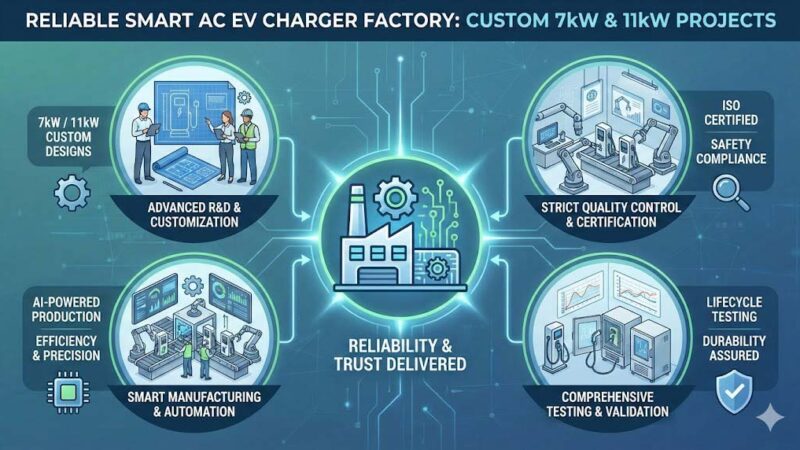
What Makes a Smart AC EV Charger Factory Reliable for Custom 7kW and 11kW Projects?
In the growing world of electric mobility, Smart AC EV Chargers—especially 7kW single-phase and 11kW three-phase models—play a central role in homes, commercial buildings, and public infrastructure across Europe and beyond. Buyers who manage OEM customization, private-label programs, or long-term procurement projects need more than just a competitive price. They need a reliable factory—a partner capable of delivering consistent quality, stable performance, and tailored solutions while supporting them through the entire product lifecycle.
A good EV charger factory is not simply a production line. It is a team of engineers, a commitment to safety, a disciplined workflow, a long-term mindset, and a willingness to stand behind the product even years after deployment. These qualities become even more important when dealing with custom projects, where each buyer may request different branding, enclosures, firmware features, cable lengths, regional requirements, and installation preferences.
This article explores what makes a Smart AC EV Charger factory reliable for custom 7kW and 11kW projects, combining practical factory insight with a human perspective on what buyers truly need.
Table of Contents
1. A Reliable Factory Understands the Real Challenges Buyers Face
Before looking at machinery or certifications, it’s important to understand why reliability matters so deeply to the professionals who purchase chargers.
1.1 Buyers Are Responsible to Their Customers
Procurement managers, distributors, and installers face daily pressure:
meeting project deadlines
avoiding after-sales problems
maintaining reputation
coordinating installation teams
keeping inventory stable
A reliable factory understands these pressures and designs its processes to reduce buyer anxiety, not increase it.
1.2 Custom Projects Add More Complexity
When a buyer requests custom:
branding
cable length
enclosure color
firmware language
RFID behavior
smart-app interface
packaging
the risk of mistakes increases. Only a factory with structured systems can deliver consistent results.
1.3 Long-Term Deployment Requires Predictability
A 7kW home charger project or an 11kW commercial rollout may span months or years. Buyers want a partner who will:
keep models stable over time
support firmware updates
maintain spare parts
avoid unnecessary redesigns
Project stability begins with factory stability.
2. Engineering Strength: The Core of a Reliable Charger Factory
A trustworthy factory starts with solid engineering capability—not just assembly skills, but deep understanding of how AC chargers truly work.
2.1 Engineers Who Understand Real-World European Requirements
Custom 7kW and 11kW chargers must align with:
Type 2 standards
230V single-phase or 400V three-phase grids
DC leakage detection requirements
RCD integration
electromagnetic compatibility rules
Factories with engineers experienced in European markets deliver more reliable products.
2.2 Robust Electrical Architecture
Reliability begins with:
stable PCB layout
optimized heat dissipation
balanced phase loading
accurate current sensors
surge and overvoltage protection
Sloppy electrical design leads to overheating, charging interruptions, relay welding, or communication errors.
2.3 Firmware Expertise for Custom Functions
Smart chargers rely heavily on firmware. A capable factory can customize:
charging current behavior
timing of CP/PP signals
app and cloud interactions
RFID modes
load balancing
dynamic current adjustment
Reliable factories maintain firmware version control and ensure consistency across batches.
2.4 Mechanical Engineering for Daily Use
A charger’s housing must be:
waterproof
UV-resistant
durable against impact
stable under heat load
easy to install
Materials and internal structure matter just as much as electronics.
3. Mature Production Systems Ensure Consistent Quality
A reliable factory doesn’t depend on “good workers”—it depends on good systems.
3.1 Automated SMT Lines for Consistent PCB Quality
Precision pick-and-place machines ensure:
accurate component positioning
low solder defects
stable performance
Smart chargers depend on high-quality PCB assembly.
3.2 Well-Trained Workers for Assembly
Even in automated factories, human skill matters. Reliable manufacturers invest in:
onboarding programs
monthly training
standard operating procedures
safety workshops
quality awareness culture
Workers who understand what they’re building deliver better products.
3.3 Strong Quality Control at Every Stage
Reliable factories use multilayer QC:
IQC (incoming components)
IPQC (during assembly)
FQC (before packaging)
OQC (before shipment)
Each step prevents defects from reaching customers.
3.4 100% Functional Testing of Smart Chargers
Every unit must pass:
full-load charging simulation
CP/PP waveform detection
RCD function validation
overtemperature protection checks
internal communication tests
firmware version verification
This ensures that every charger works the moment it is installed.
4. Ability to Handle Customization Without Losing Quality
Customization is often where unreliable factories fail.
A reliable manufacturer balances flexibility with discipline.
4.1 Custom Branding and Appearance
Factories must handle:
custom logos
custom housing colors
custom LED patterns
custom packaging
region-specific manuals
While ensuring that changes do not impact safety or internal structure.
4.2 Custom Cable Options
Buyers of 7kW and 11kW chargers often request:
different Type 2 cable lengths
different jacket materials
anti-freeze flexible cables for cold countries
custom plug designs
A reliable factory evaluates whether each request affects safety or thermal performance.
4.3 Firmware and App Customization
Customization may include:
new languages
new user flows
personalized error messages
custom current settings
home-energy management integration
Only factories with strong firmware teams can deliver these safely.
4.4 Custom Installation Requirements
Some markets require:
different backplates
angled mounting brackets
customized wall templates
Reliable factories design accessories that align with real installer needs.
5. Long-Term Component Sourcing Stability
Smart charger reliability depends on stable sourcing—not switching parts frequently.
5.1 Long-Term Contracts With Trusted Suppliers
Reliable factories secure stable supply for:
relays
microcontrollers
CT sensors
leakage detection modules
cable materials
This prevents performance drift across batches.
5.2 Component Traceability
A reliable factory maintains:
supplier batches
date codes
testing records
revision logs
If an issue arises, they can trace it back instantly.
5.3 No Sudden Component Substitutions
Sudden changes create:
firmware incompatibility
electrical instability
unexpected thermal behavior
Reliable factories avoid substitutions unless absolutely necessary and always inform buyers early.
6. Clear Communication and Professional Project Management
Even the best product is frustrating if communication is unclear.
6.1 Dedicated Project Managers
A reliable factory assigns managers who:
understand technical requirements
coordinate engineering and production
track deadlines
provide documentation
respond quickly
This reduces misunderstandings.
6.2 Transparent Development Timeline
Buyers appreciate:
honest lead times
clear production stages
predictable release dates
early warnings if delays appear
Transparency is part of reliability.
6.3 Regular Progress Reports
Professional buyers prefer factories that provide:
video updates
production photos
quality inspection reports
test results
sample confirmations
These updates reduce stress during custom projects.
7. Reliability in Certifications and Compliance
A trustworthy factory understands certification deeply—not just as a requirement, but as a responsibility.
7.1 Understanding European Compliance
Relevant areas include:
CE
EMC
LVD
EN 62196
EN 61851
DC leakage detection
smart communication standards
This knowledge protects buyers from legal or regulatory problems.
7.2 Offering Support for Buyer-Specific Certifications
Some custom projects require:
national tests
local lab validation
extended EMC testing
Reliable factories support the process willingly.
7.3 Maintaining Consistent Documentation
Quality factories maintain:
user manuals
wiring diagrams
MSDS files
installation guides
declarations of conformity
Document stability is often overlooked but extremely important.
8. Strong After-Sales and Long-Term Support
A reliable factory stands behind its charger long after production is complete.
8.1 Technical Support Teams
Buyers need help with:
installation questions
firmware behavior
charging compatibility
unusual EV behavior
Support quality matters just as much as product quality.
8.2 Warranty Handling With Respect and Fairness
Trustworthy factories:
replace defective units quickly
diagnose recurring issues
help analyze field feedback
provide engineering solutions
Good after-sales service protects both the buyer and the end user.
8.3 Spare Parts Availability
A stable factory maintains:
replacement PCBs
cables
housings
sensors
relays
firmware files
This ensures long-term operability for custom projects.
9. Commitment to Long-Term Product Stability
Custom buyers depend on the model remaining consistent for years.
9.1 Avoiding Unnecessary Redesigns
Stable factories keep:
enclosure molds
PCB designs
firmware architecture
consistent across production cycles.
9.2 Keeping Firmware Upgradable but Controlled
Reliable manufacturers offer:
OTA updates
controlled versioning
compatibility guarantees
This prevents fragmentation across batches.
9.3 Maintaining Model Longevity
A buyer should never hear:
“We stopped producing this model.”
“We replaced your design with a new one.”
“Parts are no longer available.”
Reliable factories protect custom projects from unexpected discontinuation.
10. A Human-Centered Mindset: The True Foundation of Reliability
Beyond machinery, certifications, or engineering, a reliable factory is guided by human values.
10.1 They Understand Buyer Pressure
Customers rely on buyers.
Buyers rely on factories.
Reliable factories understand this chain and design their processes to prevent stress.
10.2 They Respond Quickly Because They Care
Fast response reflects:
respect
empathy
professionalism
Factories with this mindset build long-term relationships.
10.3 They Treat Product Quality as Personal Pride
At good factories, engineers take pride in:
clean PCB layouts
quiet relays
stable firmware
smooth connector locking
precise testing
Pride creates reliability that cannot be faked.
Conclusion: Reliability Comes From Engineering, Process—and Heart
A Smart AC EV Charger factory is reliable for custom 7kW and 11kW projects when it demonstrates:
strong engineering capability
consistent production processes
disciplined QC systems
stable component sourcing
predictable communication
certification expertise
supportive after-sales service
long-term product commitment
a human mindset focused on trust and partnership
Professional buyers choose reliable factories not because it is convenient, but because their own brand depends on it.
A stable, supportive, technically competent factory becomes more than a supplier—it becomes a growth partner, a trusted ally, and the foundation of every successful EV charging project.