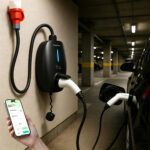
Electric vehicles are everywhere now. On any given morning, you see them charging in driveways across the neighborhood. But here is the thing: buying a home EV charger can feel overwhelming. There are dozens of models, confusing specs, and lots of conflicting advice. Some people end up buying the wrong charger. Others pay too much for features they never use. A few even make unsafe choices. The good news? The right charger is out there. You just need to know what matters. This guide walks you through every decision, from amps to connectors to installation costs. By the end, you will feel confident choosing the perfect EV charger for your home.
Level 1, Level 2, or DC Fast: Which One Do You Actually Need?
Let us start with the basics. EV chargers come in three levels. Level 1 uses a standard 120V household outlet. It adds about 3 to 5 miles of range per hour. A full charge can take 40 to 50 hours. For most drivers, that is painfully slow. Level 1 only makes sense for plug-in hybrids or people who drive very few miles each day.
Level 2 runs on 240V, just like your electric dryer or oven. It adds 30 to 60 miles of range per hour. Most EVs can fully charge overnight from nearly empty. A typical charge from 20% to 80% takes only 3 to 5 hours. This is the gold standard for home charging. It is fast enough for daily needs without being overkill.
Then there is DC fast charging, also called Level 3. These chargers add 100 to 200 miles of range in about 30 minutes. They are amazing for road trips. However, they cost much more to install. They also strain your home’s electrical system. Public DC fast chargers are perfect for travel. But for home use, Level 2 is the smarter choice.
So which level do you need? For nearly every EV owner, Level 2 is the answer. It balances speed, cost, and practicality. Home charging is also substantially cheaper than public charging. On average, charging at home costs about one-third as much per kilowatt-hour as using a DC fast charger.
Ampacity Explained: How Fast Do You Really Need to Charge?
Once you choose Level 2, the next question is amperage. Chargers range from 16 amps up to 80 amps. Higher amperage means faster charging. But faster is not always better for everyone.
Let us do some math. A 16-amp charger delivers about 3.8 kW of power. That adds roughly 12 to 15 miles of range per hour. A 32-amp charger delivers 7.7 kW and adds about 25 miles per hour. A 48-amp charger delivers 11.5 kW and adds about 35 to 40 miles per hour.
Consider your daily driving. The average American drives about 37 miles per day. A 32-amp charger easily replenishes that in under two hours. Even a 16-amp charger can do it in about three hours. For most people, 32 to 40 amps is plenty. High-powered chargers above 48 amps are mainly for large EV batteries or fleet use.
There is also an important electrical rule to understand. The National Electrical Code (NEC) states that continuous loads cannot exceed 80% of a circuit’s rated capacity. This is called the 80% rule. What does that mean for you? A 40-amp charger requires a 50-amp breaker and appropriate wiring. A 48-amp charger needs a 60-amp breaker. A 32-amp charger runs safely on a 40-amp circuit. Do not cut corners here. Proper sizing prevents overheating and fires.
Before buying any charger, check your EV’s maximum onboard charging rate. Some cars cannot accept more than 32 amps. Others, like the Ford F-150 Lightning, can accept up to 80 amps. Buying a 80-amp charger for a car limited to 32 amps is a waste of money.
Plug vs. Hardwired: Which Installation Method Is Best?
When installing a Level 2 charger, you have two options. You can buy a plug-in charger that connects to a NEMA 14-50 outlet. Or you can have a hardwired charger permanently connected.
Plug-in chargers offer flexibility. You can unplug them and take them with you if you move. Replacement is easy if the charger fails. However, there are downsides. The NEC now requires a GFCI breaker for plug-in chargers. These breakers cost more. They can also cause nuisance tripping. Moreover, a standard NEMA 14-50 outlet is designed for kitchen ranges, not EV charging. Ranges cycle on and off. EV chargers pull full power for hours at a time. This sustained heat can melt cheap outlets. If you go the plug-in route, you must use an industrial-grade receptacle with heavy-duty brass contacts. Even then, plug-in chargers are limited to 40 amps of continuous output.
Hardwired chargers have clear advantages. They eliminate the outlet entirely, removing a common failure point. They can support faster charging up to 80 amps. Hardwired installations use a standard breaker, not an expensive GFCI breaker. The connection is permanent and more secure. Many electricians prefer hardwired setups for these reasons.
Which should you choose? If you want the fastest possible charging or plan to keep the charger for many years, hardwired is better. If you rent your home or want the ability to easily move the charger, plug-in may make sense. Either way, hire a licensed electrician for the installation. This is not a DIY project for most homeowners.
NACS vs. CCS vs. J1772: Making Sense of Connectors in 2026
Connector standards have been a confusing mess. Fortunately, 2026 is the year things finally simplify. The industry is consolidating around the North American Charging Standard (NACS), officially known as SAE J3400.
NACS was originally Tesla’s design. Now it is an open standard. Major automakers like Ford, GM, Hyundai, and Rivian are equipping their new EVs with native NACS ports. The NACS connector is compact, ergonomic, and handles both AC and DC charging through the same pins. It supports up to 1,000 volts and bidirectional power flow. Many new public chargers funded by the NEVI program will feature NACS compatibility.
What about CCS? The Combined Charging Standard remains widely deployed. Thousands of public CCS chargers exist across North America. They will not disappear overnight. However, new EVs are rapidly moving away from CCS. If you buy a CCS-only charger today, it may feel dated in just a few years.
For Level 2 home charging, the legacy J1772 connector has been the standard for over a decade. It works with virtually every non-Tesla EV. Many home chargers still use J1772. With a simple adapter, you can charge any EV at a J1772 home station.
So what connector should you choose for your home charger in 2026? The safest long-term bet is NACS. If you already own a J1772 vehicle, a J1772 charger is perfectly fine. You can always use an adapter later. The most flexible option is a charger with a replaceable cable. That way you can swap connectors as standards evolve.
Smart Features: Which Ones Actually Matter?
Modern chargers come packed with smart features. But not all of them are useful for every driver. Here is how to separate the genuinely helpful from the gimmicks.
Scheduled charging is genuinely valuable. With this feature, you can tell the charger to start at midnight when electricity rates drop. Off-peak charging can save you $100 or more per month compared to charging during peak hours. Many utilities offer time-of-use rates that make this even more attractive.
Energy monitoring gives you insight into how much electricity your EV uses. You can track costs, see historical usage, and compare different months. For budget-conscious owners, this is helpful. For others, it is nice but not essential.
Over-the-air updates ensure your charger gets new features and security patches without needing a technician. This is becoming a standard expectation for quality chargers.
Load balancing is crucial if you have multiple EVs or a home with limited electrical capacity. The charger automatically reduces power when other appliances are running. This prevents your main breaker from tripping.
Solar integration allows the charger to use excess solar energy instead of grid power. For homeowners with rooftop solar, this maximizes your investment.
Which features do you actually need? Scheduled charging and OCPP compliance are the most important for most owners. OCPP (Open Charge Point Protocol) ensures your charger can talk to different software platforms. You are never locked into one app or network. For most people, a mid-range smart charger with good scheduling capabilities is the sweet spot.
Safety Certifications: Never Compromise Here
This section matters more than any other. A cheap charger without proper certification is a genuine fire hazard. Always look for recognized safety marks.
In North America, UL 2594 is the key certification for Level 2 EV chargers. UL testing checks electrical shock protection, fire risk reduction, grounding, and environmental durability. For Canadian sales, look for cUL certification. For Europe, CE marking under EN IEC 61851-1 is required. For global markets, CB certification based on IEC 61851 is widely accepted.
These certifications are not optional. They exist for a reason. According to research, about one in every five charging issues stems from non-compliance. The average cost of a non-compliance incident exceeds $740,000. For homeowners, the risk is even more personal. A fire from an uncertified charger can destroy your home.
Beyond certifications, look for specific safety features. Ground fault protection detects small current leaks and shuts off the charger in milliseconds. Over-temperature protection slows or stops charging if the plug gets too hot. A robust enclosure with an IP65 or IP66 rating keeps out dust and water. These features work together to keep you safe.
Never buy a charger from an unknown online seller just because it is cheap. If the price seems too good to be true, corners have been cut. Your safety and your home are worth the extra cost for a certified product.
Installation Costs and Incentives: What Will You Really Pay?
Let us talk money. Installing a Level 2 home charger typically costs between 800and800and2,500 in 2026. This range includes the equipment, electrical work, and permits. Here is how the numbers break down.
The charger itself costs between 400and400and700 for most quality units. Premium smart chargers with bidirectional support can cost more. Installation labor for a standard setup runs 400to400to1,500. This assumes your electrical panel has available capacity and is near your parking spot. Permits typically add 100to100to500. This varies by city. Some electricians include permits in their quote. Others require you to pull the permit separately.
What if your electrical panel is outdated or at capacity? Panel upgrades cost 1,500to1,500to4,500. This is the biggest variable in total cost. However, many older homes already have enough spare capacity. An electrician can perform a load calculation to determine what you actually need.
Now for the good news: incentives can significantly reduce your out-of-pocket cost. The federal 30C tax credit covers 30% of the purchase and installation cost, up to 1,000[reference:31].ThiscreditisavailableforchargersplacedinservicebyJune30,2026[reference:32].Eligiblelocationsincludelow−incomeornon−urbancensustracts[reference:33].Manystatesandutilitiesofferadditionalrebates.Forexample,LADWPinLosAngelesoffersupto1,000[reference:31].ThiscreditisavailableforchargersplacedinservicebyJune30,2026[reference:32].Eligiblelocationsincludelow−incomeornon−urbancensustracts[reference:33].Manystatesandutilitiesofferadditionalrebates.Forexample,LADWPinLosAngelesoffersupto1,500 for qualifying residential chargers. Some utilities cover up to 100% of electrical infrastructure costs for chargers. Always check DSIRE or your local utility website for current programs. Combining federal and local incentives can bring your total cost down by thousands of dollars.
Common Buying Mistakes to Avoid
After helping many EV owners choose chargers, we see the same mistakes again and again. Learn from others who went before you.
Mistake 1: Buying a charger that is too powerful. Many people assume bigger is better. They buy a 80-amp charger for a car that can only accept 32 amps. You pay more for hardware and installation but see zero benefit. Always check your vehicle’s maximum charge rate first.
Mistake 2: Ignoring the 80% rule. Some buyers buy a 40-amp charger and think a 40-amp breaker is fine. That is dangerous and violates the NEC. Always size your circuit to 125% of the charger’s continuous draw.
Mistake 3: Using a cheap outlet for a plug-in charger. A 15dryeroutletisnotsafeforEVcharging.Thesustainedheatwillcauseittomeltovertime[reference:36].Spendtheextra15dryeroutletisnotsafeforEVcharging.Thesustainedheatwillcauseittomeltovertime[reference:36].Spendtheextra50 to $80 on an industrial-grade Hubbell or Bryant receptacle. Better yet, go hardwired to eliminate the outlet entirely.
Mistake 4: Overlooking weather resistance. Even if you park in a garage, humidity and temperature changes affect electronics. Look for chargers with IP65 or IP66 ratings. This ensures your charger survives for years.
Mistake 5: Buying a non-certified charger from an online marketplace. These products often lack UL or CE certification. They may work for a few months, then fail or overheat. The savings are never worth the risk. Stick to known brands with proper safety marks.
Cable Length and Daily Usability
Small details matter in daily life. Cable length is one of them. Most home chargers come with a 16- to 25-foot cable. A 25-foot cable is usually ideal. It lets you reach both sides of the car without struggling.
Think about your parking situation. If you back into your garage, the charge port may be on the passenger side. A longer cable gives you flexibility. If you have multiple parking spots or two EVs, even more length helps. However, remember that longer cables add resistance. Cheap long cables can waste energy as heat. Quality cables from reputable brands avoid this problem.
Also consider cable thickness and flexibility. Some cables are stiff in cold weather. Others crack after repeated bending. Premium cables use better materials and last for years. Read reviews about cable durability before you buy.
Future-Proofing Your Purchase
You will probably keep your EV charger for 10 years or more. A lot will change in that time. A little planning today can save you from buying another charger too soon.
First, choose a charger that supports at least 48 amps, even if you only need 32 amps today. The wiring and breaker can be oversized now. Later, you can upgrade the charger head without rewiring. This costs a bit more upfront but adds flexibility.
Second, look for OCPP 2.0.1 compliance. This open standard ensures your charger can work with future smart grid programs. Utilities are already planning demand response and time-of-use programs. OCPP lets your charger participate automatically.
Third, consider bidirectional readiness. Vehicle-to-home (V2H) and vehicle-to-grid (V2G) technologies are growing rapidly. Eight states are developing V2G export programs, and that number will rise. Even if you do not buy a bidirectional charger today, choose a charger that could be upgraded. Leave space on your wall and conduit for additional wiring.
Finally, buy from a manufacturer that offers firmware updates. Regular updates add features, fix bugs, and patch security holes. A charger without update support will feel obsolete in a few years.
Why Choose Changzhou Fisher Electronic Technology Co., Ltd.?
Choosing a charger is a big decision. At Changzhou Fisher Electronic Technology Co., Ltd., we make that decision easier. Every Fisher charger uses premium components, pure copper cabling, and durable enclosures. We offer power ratings from 16 amps to 80 amps to fit any home.
Safety is our first priority. Our chargers carry UL, CE, and CB certifications. We test for electrical safety, thermal performance, and weather resistance. You can install them indoors or outdoors with complete confidence.
Smart features come standard. Our chargers support OCPP for future compatibility. Schedule charging, monitor energy use, and adjust settings from our app. For homeowners with solar panels, our solar capture feature maximizes your renewable energy.
We stand behind our products with responsive customer support and a solid warranty. Whether you are a first-time EV owner or adding a second charger, our team helps you choose the right fit.
Visit our website to explore our full range of home EV chargers. Contact us with any questions. The right charger is waiting for you.