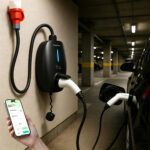
The global electric vehicle market is growing faster than ever. More families, businesses and fleet operators choose electric cars to save cost and protect the environment. But a good EV experience depends on one key thing: a reliable charger. Changzhou Fisher Electronic Technology Co., Ltd. is a professional manufacturer and supplier of EV charging products. We provide home chargers, commercial chargers and public charging solutions for global customers. This article covers EV charging basics, 2026 industry trends, common user pain points and professional solutions to help you choose the best charging equipment.
What Is an EV Charger and How Does It Work?
An EV charger is a device that supplies electricity to charge electric vehicle batteries. It connects to the power grid and transfers energy safely to the car. Without a stable charger, even the most advanced EV cannot support daily travel needs.
EV chargers convert grid power into usable power for the battery. AC chargers use the car’s built-in converter to finish energy conversion. DC chargers complete conversion inside the charger unit and deliver power directly to the battery. This difference decides charging speed and usage scenarios.
Modern EV chargers also include smart control systems. They monitor voltage, current and temperature in real time. They protect the battery and ensure safe charging. High-quality chargers support remote control, automatic stop and fault alerts. These functions improve convenience and extend service life.
Types of EV Chargers: AC Chargers vs. DC Fast Chargers
The EV charger industry mainly divides products into two categories: AC chargers and DC fast chargers. Each type serves different users and scenarios.
AC EV Chargers for Home and Daily Use
AC chargers are the most common choice for home, apartment and workplace charging. They have low power, stable output and simple installation. Most AC chargers belong to Level 2, with power from 3.6kW to 22kW.
Level 2 AC chargers fully charge most passenger EVs within 4 to 8 hours. They are perfect for overnight charging at home or daytime charging at offices. AC chargers cost less and do not usually require major grid modification.
AC chargers are gentle on batteries. They support daily long-term use without damaging battery life. Fisher home AC chargers have compact design, high safety and stable performance for family use.
DC Fast Chargers for Public and Commercial Use
DC fast chargers provide high-power output. They charge an EV battery to 80% within 15 to 30 minutes. They are mainly used in highways, shopping malls, parking lots and logistics centers.
Modern DC chargers can reach 60kW to 600kW. Ultra-high-power DC chargers match 800V high-voltage EV platforms. They greatly reduce waiting time and solve range anxiety for long-distance travel.
DC chargers are more suitable for public and commercial scenarios. They support high-frequency use and multiple charging sessions per day. Fisher commercial DC chargers use liquid-cooled technology and smart modules for stable and efficient performance.
Global EV Charger Connector Standards
Connector compatibility is one of the most important factors for users. Different regions use different connector types. A good charger must support mainstream standards to avoid matching failures.
- Type 2: Widely used in Europe, Asia and many countries for AC and DC charging.
- CCS: Includes CCS1 and CCS2. It is the most popular DC fast charging standard in the world.
- NACS: Open standard in North America, with compact structure and high compatibility.
- CHAdeMO: Used mainly in some Japanese EV models, especially older versions.
Fisher EV chargers support all major global connectors. We also provide customized versions for different markets. Customers can use our chargers with almost any electric vehicle on the market.
Key Features of High-Quality EV Chargers
When choosing an EV charger, you should pay attention to core functions that affect safety, efficiency and service life.
Multiple Safety Protections
Safety is the top priority for charging equipment. Professional EV chargers must include over-voltage, under-voltage, over-current, leakage and over-temperature protection. They should also have lightning protection and IP55 or higher waterproof and dustproof rating for outdoor use.
Smart Control and Remote Monitoring
Modern chargers support WiFi, Bluetooth and 4G connectivity. Users can check charging status, set charging time and pay bills through mobile apps. Remote monitoring helps operators manage stations and reduce faults.
Dynamic Load Balancing
For commercial stations with multiple chargers, load balancing distributes power intelligently. It avoids grid overload and lowers electricity costs. It also reduces the need for expensive grid renovation.
OTA Firmware Update
High-quality chargers support wireless OTA updates. This function improves system stability, fixes security risks and adds new features without replacing the device.
Wide Temperature Adaptation
Good chargers can work normally in extreme environments. They should operate stably from -30°C to 55°C to adapt to different climate zones.
2026 EV Charging Industry Trends
The EV charging industry is changing quickly. New technologies and policies shape the market direction.
Ultra-Fast Charging Becomes Mainstream
High-power chargers above 350kW are becoming standard. More new EV models use 800V platforms. Liquid-cooled cables and high-efficiency modules support safer and faster charging.
Smart and AI-Driven Management
AI technology helps predict faults, optimize power distribution and improve user experience. Smart stations can automatically adjust power based on grid load and user demand.
Bidirectional Charging (V2G / V2H)
Bidirectional chargers allow EVs to send power back to homes or grids. V2H provides backup power during blackouts. V2G helps stabilize the grid and allows users to earn extra income.
Stricter Certification and Energy Efficiency
More countries require mandatory safety certification for EV chargers. Energy efficiency standards are also higher. These rules eliminate low-quality products and protect users.
Expansion in Rural and Fleet Markets
Rural charging infrastructure is developing rapidly. Commercial fleets such as logistics trucks and delivery vans also increase demand for heavy-duty chargers.
Common EV Charging Pain Points and Solutions
Many users face charging troubles in daily use. These problems affect experience and even slow down EV adoption.
Pain Point 1: Unreliable Public Chargers
Broken or offline chargers cause great inconvenience. Many public stations have high failure rates and long maintenance cycles.
Solution: Fisher uses high-quality components and strict testing. Our chargers have long service life and low failure rates. Cloud monitoring detects faults early and reduces downtime.
Pain Point 2: Slow Charging Speed
Low-power chargers cannot meet modern EV needs. Long waiting times reduce travel efficiency.
Solution: Fisher provides a full range of high-power chargers. Our DC fast chargers support ultra-fast charging and match latest EV models.
Pain Point 3: Compatibility Failure
Different connectors and standards lead to charging failure. Users cannot charge when traveling across regions.
Solution: Fisher chargers support all mainstream connectors. They are compatible with almost all EVs worldwide.
Pain Point 4: Complex Operation
Complicated apps, registration and payment steps make charging difficult for elderly or new users.
Solution: Fisher chargers use simple touch screens and one-key operation. Plug & Charge function allows automatic charging without apps or cards.
Pain Point 5: High Installation Cost
Grid upgrades and complex wiring increase investment cost for homes and businesses.
Solution: Fisher chargers support easy installation. Smart load balancing reduces grid renovation cost. Solar integration also lowers long-term energy expenses.
Why Choose Changzhou Fisher Electronic Technology?
Fisher is a reliable EV charger manufacturer based in Changzhou, China. We have rich experience in power electronics, intelligent control and automotive-grade production.
- Full product line for home, commercial and public use
- Global certifications including CE, FCC, UL and 3C
- Strong R&D and stable quality control
- Customized solutions for OEM and ODM
- One-stop service from design to after-sales
- 24/7 technical support for global customers
We serve customers in Europe, North America, Asia, the Middle East and other regions. Our products are widely used in residential communities, business centers, logistics parks and government infrastructure projects.
The Future of EV Charging Technology
The EV industry will continue to develop toward higher efficiency, smarter control and greener energy.
- Automatic charging robots will reduce fixed station dependence
- Wireless charging will provide cable-free convenience
- Solar-plus-station systems will achieve low-carbon operation
- Global standardization will improve compatibility
Fisher keeps investing in new technology research. We will launch more innovative products to lead market trends and support global clean energy transformation.
Conclusion
A reliable EV charger is the foundation of modern electric mobility. It affects safety, convenience and cost for every user. Whether you are a family driver, a business investor or a fleet operator, choosing a professional manufacturer is crucial.
Changzhou Fisher Electronic Technology Co., Ltd. focuses on safe, smart and efficient EV charging solutions. We provide high-quality products and professional services to global customers. With advanced technology, strict quality control and complete certification, Fisher is your ideal partner in the EV charging industry.
If you are looking for a trusted EV charger supplier, welcome to contact us. Let us build a cleaner, smarter and more sustainable future together.