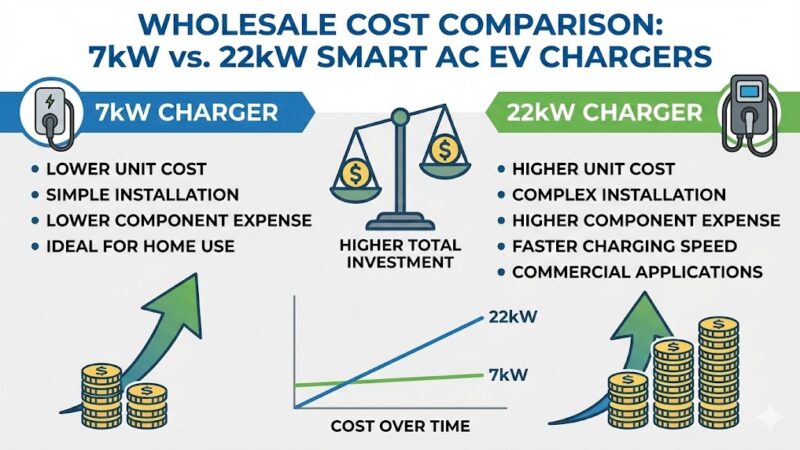
How Do Buyers Compare Wholesale Costs for 7kW vs. 22kW Smart AC EV Chargers?
For procurement managers, distributors, installers, and OEM project buyers, choosing between 7kW and 22kW Smart AC EV Chargers is not just a technical decision—it is a financial and strategic one. These two charger categories serve similar markets, yet their wholesale cost structures differ in ways that affect pricing strategy, project profitability, logistics handling, and even long-term customer satisfaction.
Smart buyers never compare chargers simply by “price per unit.”
They compare by value, specification, market fit, installation scenario, component cost, regulatory requirements, and future maintenance expectations. A 7kW charger may be cheaper upfront, but may not fit a high-demand environment. A 22kW charger may offer better ROI in certain regions but require higher installation costs.
This article explores how buyers compare wholesale costs for 7kW vs. 22kW Smart AC EV Chargers, combining engineering knowledge, procurement logic, and real-world wholesale insights.
Table of Contents
1. Understanding the Fundamental Difference Between 7kW and 22kW AC Chargers
Before discussing cost, buyers need clarity about how these two charger types differ in practical use.
1.1 Power Level Defines Charging Speed
7kW = Single-phase, 230V, approx. 32A
22kW = Three-phase, 400V, approx. 32A (11kW is 16A per phase)
22kW is roughly 3× faster—but only if the vehicle supports three-phase AC.
1.2 Market Fit Varies
7kW chargers are ideal for:
Residential homes
Small businesses
Overnight charging
Countries with mostly single-phase grids (UK, many EU households)
22kW chargers are ideal for:
Commercial parking facilities
Fleets
Workplaces
Hotels and shared apartments
Regions with strong three-phase availability (Germany, Netherlands, Norway)
1.3 Different User Expectations
Buyers evaluate cost differences with customer usage patterns in mind:
Residential users prioritize price, safety, reliability
Commercial users prioritize speed, uptime, and ROI
This shapes cost comparison logic.
2. Different Hardware Requirements Directly Influence Wholesale Prices
The most obvious cost differences come from hardware.
2.1 Power Hardware Is More Expensive in 22kW Models
22kW chargers require:
Three-phase relay/contactor
Higher power-rated components
Larger heat sinks
Heavier internal wiring
More robust terminals
These significantly increase manufacturing cost.
2.2 PCB Structure Is More Complex for 22kW
A 7kW PCB is typically:
Single-phase architecture
Simpler power routing
Fewer thermal hotspots
A 22kW PCB requires:
Three-phase balancing
Larger copper layers
Enhanced insulation spacing
Additional sensors
Stronger surge protection
PCB complexity alone can raise the cost by 25–40%.
2.3 Cable Cost Shows a Major Difference
Type 2 cables for 22kW require:
Thicker copper
Larger gauge
Higher heat resistance
Cable price differences are dramatic:
7kW cable is usually 3-core
22kW cable is 5-core with thicker wires
Buyers know cable cost is often the single largest component cost.
3. Installation Requirements Affect Buyer Cost Strategy
Wholesale buyers always consider installation cost because it influences market demand.
3.1 7kW Installation Is Cheaper
Residential installers prefer 7kW because:
Uses single-phase
Requires simpler breakers
Lower wiring cost
Fewer inspection requirements
This increases the market volume for 7kW, making wholesale buying easier.
3.2 22kW Installation Requires Three-Phase Wiring
Commercial installations require:
Upgraded electrical panels
Larger circuit breakers
Heavier cabling
Professional installation teams
Installation cost influences wholesale demand patterns.
3.3 Buyers Compare Not Just Product Price but Market Penetration Opportunity
A 22kW charger might be more profitable per unit—
but the 7kW charger sells in much higher volume.
4. Component Sourcing Differences Shape Price Gaps
Experienced buyers know that sourcing stability drives cost.
4.1 Relays and Contactors
22kW relays are:
Bigger
More durable
Triple-phase
More expensive
This alone can double cost compared to 7kW.
4.2 CT Sensors and Leakage Detection Modules
Higher current means:
More sensitive CT clamps
More advanced DC leakage detection
Cost escalates accordingly.
4.3 PCB Copper Thickness
22kW chargers often require:
2oz or 3oz copper
Multi-layer PCB construction
Higher copper prices and PCB thickness directly increase BOM cost.
5. Cooling and Thermal Design Impact Manufacturing Price
Heat generated in 22kW charging sessions is significantly higher.
5.1 Heavier Heat Sinks
22kW models need:
Larger heat sinks
Better convection paths
More thermal pads
This increases both material and assembly cost.
5.2 More Complex Enclosure Design
22kW enclosures must handle:
Higher temperature
Larger internal volume
Better airflow
A stronger, thicker enclosure means more expensive molds and higher plastic cost.
6. Firmware Complexity Differs Between 7kW and 22kW Chargers
Smart chargers rely heavily on firmware.
6.1 Three-Phase Load Balancing Is More Complex
22kW firmware includes:
Phase detection
Phase rotation correction
Balancing algorithms
More advanced thermal logic
This increases software development cost and ongoing support cost.
6.2 Commercial Features Are Often Required for 22kW Models
Buyers evaluate whether the charger supports:
OCPP protocols
RFID
Smart metering
Dynamic load balancing
Over-the-air updates
More features = higher firmware investment.
7. Certification Adds Significant Cost Differences
Certification is not optional—it is essential in wholesale markets.
7.1 22kW Chargers Require More Extensive Testing
Three-phase testing includes:
thermal cycling
EMC stress
leakage detection validation
high-load endurance
Testing cost influences wholesale cost significantly.
7.2 More Expensive Components Are Required to Pass Tests
To meet CE, EMC, and safety rules:
higher-spec relays
stronger PCB insulation
improved surge protection
Certification-driven improvements add cost.
8. Packaging and Logistics: The Hidden Cost Every Buyer Evaluates
Professional buyers know that shipping cost affects true wholesale value.
8.1 22kW Chargers Are Heavier
This impacts:
pallet loading
carton durability
freight cost per unit
8.2 Larger Boxes Mean Higher Shipping Fees
22kW chargers need bigger boxes due to:
thicker cables
heavier internal structure
larger mounting accessories
Buyers compare CBM (cubic meters) as part of cost analysis.
8.3 Damage Risk Influences Packaging Investment
22kW chargers require:
double-wall cartons
thicker foam inserts
This improves product protection but increases packaging cost.
9. Demand and Market Strategy Influence Cost Comparisons
Wholesale buyers evaluate market dynamics carefully.
9.1 7kW Sells More Volume
This leads to:
lower shipping cost per unit
more predictable stock turnover
better cash flow
9.2 22kW Offers Higher Margins per Unit
In many markets:
commercial buyers pay more
installers have fixed profit percentages
long-term ROI is higher
9.3 Regional Grid Differences Affect Buyer Strategy
Examples:
Germany and Netherlands: 22kW is common
UK and parts of France: 7kW dominates
Nordic countries: both are strong
Smart buyers choose chargers that match regional adoption.
10. After-Sales Cost Shapes Wholesale Comparison
A charger’s true cost includes support costs.
10.1 22kW Chargers Have Higher Failure Impact
Failures are costly due to:
installation complexity
larger replacement cost
downtime for commercial clients
Wholesale buyers evaluate risk carefully.
10.2 7kW Chargers Have Lower Service Cost
Residential users typically encounter:
simple installation
fewer load issues
easier replacement process
This reduces long-term cost for the buyer.
10.3 Spare Parts and Maintenance Cost Differ
22kW chargers use:
bigger relays
thicker cables
more advanced PCBs
Spare parts cost more accordingly.
11. Human Decision Factors: Buyers Evaluate With Both Logic and Experience
Cost comparison is not just technical—it is emotional and practical.
11.1 Buyers Think About Their Customers
They ask:
“Will my customer pay this price?”
“Can installers support this model easily?”
“What happens if something fails on-site?”
A good buyer considers real-world stress.
11.2 Buyers Think About Stocking Cost
Heavier chargers = more warehouse cost.
Higher-value chargers = more capital tied up.
11.3 Buyers Think About Market Positioning
Some brands want affordability (7kW).
Others want premium performance (22kW).
Buyers choose based on brand identity.
Conclusion: How Smart Buyers Compare Wholesale Costs
Professional buyers compare wholesale costs for 7kW vs. 22kW Smart AC EV Chargers based on:
hardware complexity
component cost
cable and connector differences
installation difficulty
firmware requirements
certification cost
logistics and shipping
after-sales risk
market demand
long-term customer expectations
brand positioning
7kW chargers are more affordable, simpler to install, and ideal for residential volume sales.
22kW chargers offer higher performance, stronger commercial value, and better long-term ROI in three-phase markets.
In the end, smart buyers don’t compare 7kW and 22kW chargers by price—they compare them by purpose, value, market strategy, and total lifecycle cost.
A thoughtful comparison leads to smarter decisions, stronger margins, and long-term business success.